
Independent researcher. Computer engineer with twenty years of experience in data modeling, normalization, and innovative startups. Currently focused on constrained systems, exhaustion dynamics, and the structural properties of positional number systems.
LinkedIn →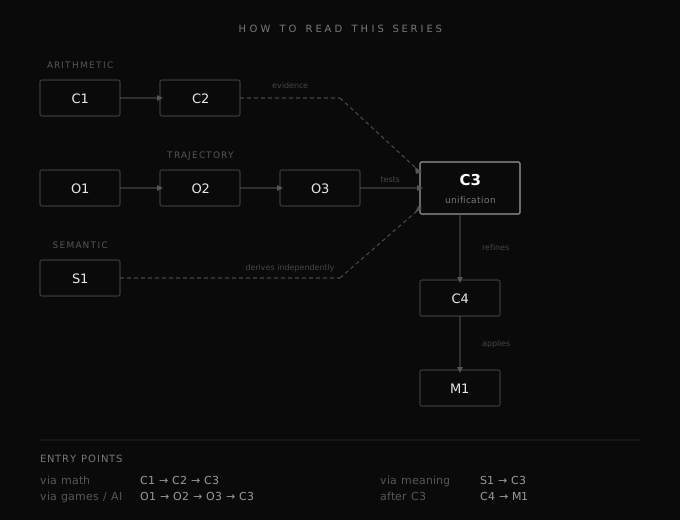
Every positional expansion of a unit fraction belongs to exactly one of six morphological forms. Proves that the minimum morphologically complete base is b = 15 and establishes a necessary and sufficient arithmetic criterion for completeness. No historical number system is morphologically complete.
Sub-limit DynamicsResolves three open problems from C1: the anomalous incomplete bases are exactly four, the intrinsic saturation threshold is always strictly less than b, and the structural bottleneck is always a mixed form. Transforms the completeness criterion from static classification into a dynamic picture.
Sub-limit DynamicsThe unifying paper. Formulates three axioms—Finite Alphabet, Irreversible Consumption, Observable Iteration—and proves that any system satisfying them exhibits finite vocabulary, early saturation, an interaction bottleneck, and an efficiency paradox. Verified on arithmetic, geometric, and semantic systems. Resolves open problems from C1 and C2.
Sub-limit DynamicsRefines the Irreversibility Axiom by distinguishing three consumption types (node-, arc-, trajectory-consumptive) and classifies all asymptotic behaviors into four dynamic regimes via SCC decomposition. Proves a forced finiteness theorem extending the framework to continuous alphabets under distinguishability thresholds.
Sub-limit DynamicsIntroduces the DGIGM model—a class of constrained systems where every action irreversibly consumes future possibilities. Proves the constraint structure is isomorphic to non-repeating edge walks on de Bruijn graphs. Analyzes phase transitions, the Efficiency Paradox, and 425 unique morphological forms from 477 game sessions.
Sub-limit DynamicsAnalyzes 570 unique shapes from a discrete constrained trajectory system. Seven statistically stable dynamic regimes emerge from unsupervised clustering. Geometrically identical configurations can belong to dynamically distinct regimes. All trajectories terminate in exactly three outcome classes. Failure is finite, structured, and anticipatable.
Sub-limit DynamicsTests LLMs as stateless agents in a DGIGM via a bridge protocol. Establishes six operational profiles across models from three providers. The critical variable is not memory depth or model size but the criterion for information selection. Validates the Efficiency Paradox at the agent level and confirms cross-domain transfer via Word Duel.
Sub-limit DynamicsDerives the four structural properties of sub-limit dynamics from semantic first principles, without presupposing the axiomatic framework. The convergence of four independent paths on the same properties constitutes evidence that sub-limit dynamics is the necessary structure of any process in which meaning manifests under finite constraint. Five predictions validated on 90 Word Duel runs.
Sub-limit DynamicsVerifies that the harmonic domain satisfies the three CGS axioms. First verified instance of trajectory-consumptive dynamics (T3) and the branched attractor regime (R2). The Pythagorean comma emerges as the efficiency paradox in music. The twelve-tone technique is analyzed as a natural experiment imposing T1 constraints on a T3 system.
Sub-limit DynamicsA method for maintaining agent coherence across stateless decision boundaries in systems with irreversible constraints. The bridge mechanism operates at the interaction surface between agent and environment, restoring constraint-relevant information that would otherwise be lost. Empirically prevents the convergent-to-non-convergent phase transition (structural drift) without modifying the agent's internal capacity.
Provisional · PendingDeterministic Games with Irreversible Global Memory (DGIGM): a class of constrained systems in which every action irreversibly consumes a portion of the future action space.
Asimov's Three Laws of Robotics cannot save us, because they were never meant to. Asimov created them as a narrative device to generate conflict in his stories. Every tale he wrote demonstrates how they fail. We turned them into a philosophy of governance. That is a category error, with real-world consequences.
The most impactful optimization in programming isn't taught alongside the for loop. On replacing repeated scans with maintained state—a technique that exists since the 1960s but has never been taught as a basic programming skill.